

 Tolulope Michael
AI Transformation Is a Problem of Governance, Not Technology: Best 2026 Guide
Artificial intelligence transformation is often treated as a technology upgrade, but most failures occur because organizations lack strong governance.
AI transformation is a problem of governance because leadership must define accountability, manage ethical risks, oversee data quality, and ensure AI decisions align with business strategy. Without clear oversight from boards and executives, AI becomes fragmented experimentation instead of sustainable transformation.

What Does It Mean That AI Transformation Is a Problem of Governance?
AI transformation is a problem of governance because the biggest risks and failures do not come from the technology itself. They come from weak leadership oversight, unclear accountability, and poor decision structures. When organizations deploy artificial intelligence without strong governance frameworks, AI systems can create ethical risks, data privacy issues, regulatory exposure, and misaligned business outcomes.
Effective AI transformation governance ensures that leadership sets clear strategy, boards oversee risk, and organizations maintain human oversight over critical decisions. This governance structure aligns AI systems with business goals, manages algorithmic bias and data integrity, and ensures compliance with evolving regulations such as the EU AI Act.
In practice, successful AI adoption requires top-down AI governance, clear reporting structures, and continuous oversight of how AI models use data and influence decisions across the organization. Without these controls, even advanced AI technologies struggle to deliver sustainable value.
Why AI Projects Fail Even When the Technology Works
Many organizations assume AI initiatives fail because the technology is immature. In reality, the opposite is often true. The models perform well, the infrastructure works, and the data pipelines run as expected. Yet the transformation still stalls. This pattern explains why many experts now say AI transformation is a problem of governance, not simply a technical challenge.
The core issue is organizational structure. When companies deploy AI tools without strong AI governance oversight, initiatives grow in isolated departments. Marketing teams adopt predictive tools, finance teams experiment with forecasting models, and operations teams deploy automation. Each project may succeed individually, but the organization lacks a unified strategy that connects these efforts to long-term business goals.
This fragmentation creates several AI governance challenges. Leadership cannot see how AI systems interact across the organization. Data standards become inconsistent. Risk management processes remain unclear. In many cases, no single executive owns the responsibility to govern AI across the enterprise.
These gaps represent some of the top challenges in implementing AI governance today. Without centralized oversight, organizations struggle to measure AI performance, manage model risks, and ensure ethical decision-making. The result reflects a deeper AI governance business reality: technology can scale quickly, but governance structures often lag behind.
When this gap grows too large, AI initiatives lose direction. Instead of driving coordinated transformation, they produce scattered experimentation that rarely delivers strategic value.
RELATED ARTICLE: AI vs Automation Vs Orchestration Cybersecurity: What Are the Differences
The Leadership Gap: Why Boards Must Govern AI From the Top

AI transformation succeeds only when leadership treats it as a strategic responsibility. Many organizations still delegate AI oversight to IT teams or innovation labs. That approach no longer works. Artificial intelligence now influences hiring decisions, financial forecasts, pricing strategies, and customer interactions. These decisions require strong top-down AI governance.
Boards and executive leaders must take ownership of AI transformation governance. Without clear direction from the top, departments often deploy AI tools independently. This creates inconsistent standards, fragmented data practices, and unclear accountability when problems arise.
Effective governance begins with board awareness. Directors need visibility into how AI systems operate across the organization. This includes understanding model risks, data usage, regulatory exposure, and performance outcomes. A well-informed board AI oversight structure ensures that leadership evaluates AI investments with the same discipline applied to financial or operational decisions.
Boards should also review whether their governance structures support modern oversight. Many organizations now evaluate the board management company onboard on AI-powered board tools that help directors monitor data insights, risk signals, and AI performance metrics in real time. These platforms improve transparency and help boards make faster, informed decisions.
Strong leadership oversight transforms AI from isolated experimentation into coordinated strategy. When executives clearly define accountability, reporting structures, and decision authority, organizations can govern AI effectively while maintaining innovation speed.
The Real Risks: Bias, Data Privacy, and Uncontrolled AI Decisions
AI systems influence decisions that affect customers, employees, and financial outcomes. Without strong governance, these systems can introduce serious operational and ethical risks. Addressing these risks remains one of the most pressing AI governance challenges facing organizations today.
One major risk involves algorithmic bias. Machine learning models learn from historical data. If that data contains hidden bias, the system can reproduce or even amplify unfair outcomes. This creates legal exposure and reputational damage, especially in areas such as hiring, lending, or customer profiling. Strong AI governance oversight ensures that organizations test models for bias and monitor outcomes continuously.
Data privacy represents another critical concern. AI systems often require large volumes of sensitive data to function effectively. Without strict controls on data access, storage, and usage, organizations risk violating privacy regulations and exposing confidential information. Effective governance establishes clear rules around data protection, consent management, and regulatory compliance.
Transparency also plays a key role. Many AI models operate as complex systems that produce results without clear explanations. Governance frameworks must ensure that organizations can provide AI governance contextual evidence when decisions affect customers or employees. This evidence allows leadership, regulators, and stakeholders to understand how AI systems reach conclusions.
When governance structures address these risks early, organizations unlock significant AI governance benefits. They build trust with customers, reduce regulatory exposure, and create a stable foundation for responsible AI adoption.
READ MORE: vRealize Infrastructure Navigator: Features, End of Life, and Modern VMware Replacement
What Effective AI Governance Actually Looks Like

Strong AI adoption requires more than policies and compliance checklists. Organizations need a structured system that helps leaders govern AI while allowing innovation to continue. The most successful companies implement governance as an operational framework rather than a reactive control mechanism. This approach reflects what many experts describe as governed enablement AI—a model where governance enables progress instead of slowing it down.
A practical governance structure usually rests on five pillars.
1. Strategic alignment
Leadership must connect AI initiatives directly to business priorities. AI should support measurable outcomes such as operational efficiency, customer experience, or revenue growth. Without strategic alignment, organizations struggle to maintain AI contextual governance organizational context strategic visibility, meaning leaders cannot clearly see how AI contributes to long-term strategy.
2. Data governance
Reliable AI depends on reliable data. Governance teams must establish clear data ownership, quality standards, and access controls. This layer ensures that training data remains accurate, compliant, and traceable across the organization.
3. Model oversight
Organizations must monitor how models behave after deployment. Effective AI governance oversight includes testing for bias, validating model performance, and reviewing updates when algorithms evolve over time. Continuous monitoring allows teams to identify risks early.
4. Ethical and compliance safeguards
Responsible AI requires structured policies for fairness, transparency, and accountability. Governance programs use AI governance contextual refinement to adapt policies as new risks or regulatory requirements emerge.
5. Performance monitoring
Boards and executives need clear performance metrics. Governance frameworks should track outcomes such as cost savings, operational impact, and customer experience improvements. These indicators provide AI governance contextual evidence that AI investments create measurable value.
When organizations build these pillars into daily operations, AI initiatives become easier to scale. Governance no longer functions as a barrier. Instead, it becomes the structure that allows innovation to grow safely and consistently.
AI Governance in the Public Sector: Trust, Regulation, and Skills

AI adoption in government introduces a different set of governance pressures. Public institutions must balance innovation with accountability, transparency, and public trust. Understanding what is IA in government often begins with a simple idea: governments use artificial intelligence to improve public services, policy decisions, and administrative efficiency. However, these systems must operate under strict oversight because their decisions can directly affect citizens.
One major obstacle involves legacy systems. Many public agencies rely on outdated infrastructure that was never designed for advanced analytics or machine learning. Integrating AI into these environments creates operational complexity and makes AI governance oversight more difficult to implement.
Skill gaps also slow progress. Governments often struggle to recruit specialists who understand both policy and technical AI systems. Without the right expertise, agencies cannot effectively design governance frameworks that evaluate risks, monitor model performance, and maintain transparency.
Funding structures add another layer of complexity. In many cases, agencies receive mandates to adopt new technologies without the resources required to govern them properly. This raises an important policy question: why is a funded mandate critical to effective AI governance? Without dedicated funding for oversight, training, and compliance systems, governance frameworks remain incomplete.
Public sector AI governance therefore depends on three priorities: building internal expertise, modernizing digital infrastructure, and securing sustained funding for oversight programs. When these elements work together, governments can deploy AI responsibly while maintaining public confidence.
SEE ALSO: Parallel Concurrent Processing in 2026: Performance Tips You Need to Know
The Business Case: How Governance Accelerates AI Innovation
Many organizations assume governance slows innovation. In reality, strong governance allows AI initiatives to scale faster and deliver consistent value. When leadership establishes clear oversight structures, teams understand how to deploy AI safely and confidently. This clarity reflects the growing AI governance business reality: organizations that govern AI effectively move faster than those that rely on uncontrolled experimentation.
Governance improves coordination across departments. Without centralized oversight, teams often purchase different AI tools that operate independently. Marketing, finance, operations, and HR may each deploy separate models without shared data standards or performance metrics. Governance frameworks solve this problem by creating unified policies for how teams govern AI, share data, and measure outcomes.
This alignment drives measurable AI governance benefits. Organizations gain clearer visibility into performance, risk exposure, and return on investment. Leadership can evaluate whether AI projects contribute to strategic priorities instead of operating as isolated experiments.
Over time, this structured approach supports AI governance business evolution. As companies develop stronger oversight systems, they move from scattered pilots toward integrated AI strategies. Governance ensures that new tools fit within a broader architecture, reducing duplication and improving long-term efficiency.
Looking ahead, this structure will shape the AI governance future. Organizations that establish disciplined governance today will scale AI more confidently, manage regulatory expectations more effectively, and maintain trust with customers and stakeholders.
Why the Future of AI Depends on Governance
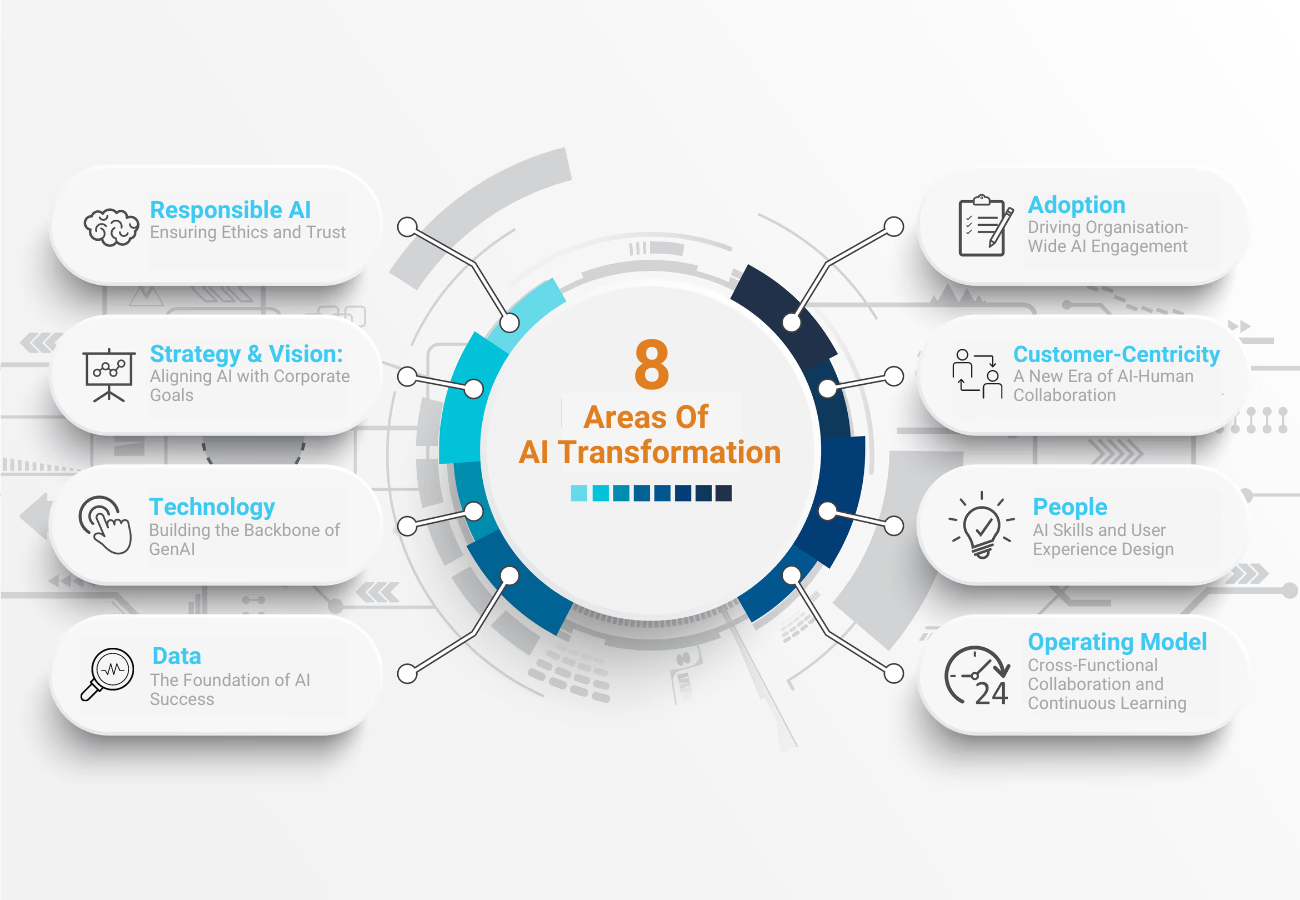
Artificial intelligence will continue to expand across industries, influencing decisions in finance, healthcare, government, and global supply chains. As adoption grows, the conversation around AI increasingly shifts from technical capability to oversight and accountability. Recent genai governance news shows that regulators, boards, and policymakers are focusing more on how organizations control AI systems rather than simply how they build them.
Many analysts now warn that the next wave of challenges will involve governance maturity rather than model performance. Discussions around AI governance challenges medium and similar industry forums highlight recurring issues such as weak oversight structures, unclear accountability, and fragmented reporting systems. These problems can create what some observers call AI governance paralysis medium, where organizations hesitate to scale AI because leadership lacks confidence in the control framework.
Strong governance helps avoid this paralysis. Clear policies, transparent decision processes, and well-defined reporting structures allow organizations to scale AI safely while maintaining stakeholder trust. Effective governance also improves internal alignment by strengthening AI governance communication medium between technical teams, leadership, and compliance departments.
As AI becomes deeply embedded in decision-making, governance will define which organizations succeed. Those that build strong oversight frameworks today will shape the AI governance future, turning responsible governance into a long-term strategic advantage.
MORE: Managing Database Systems: Key Concepts, Types, and Examples for 2026
Governance Is the Real Engine of AI Transformation
Artificial intelligence can improve decision-making, automate complex processes, and unlock new sources of business value. Yet technology alone cannot deliver these outcomes. Organizations succeed only when leadership builds strong governance structures that guide how AI systems operate across the enterprise.
This reality explains why AI transformation is a problem of governance rather than a purely technical upgrade. Without clear accountability, reliable data standards, and consistent oversight, AI initiatives often become fragmented experiments that fail to scale.
Effective AI transformation governance aligns leadership, technology teams, and compliance functions around a shared framework for responsible innovation. Boards oversee risks, executives set strategy, and governance systems monitor performance and ethical outcomes.
Organizations that treat governance as a strategic capability will scale AI more confidently and sustainably. In the long run, the companies that lead the AI era will not simply build better algorithms. They will build better governance.
Conclusion
Artificial intelligence can automate processes, generate insights, and improve decision-making across industries. However, technology alone does not guarantee meaningful transformation. Organizations succeed only when leadership establishes strong governance structures that guide how AI systems operate.
This reality explains why AI transformation is a problem of governance rather than a purely technical challenge. When companies deploy AI without clear accountability, reliable data standards, and consistent oversight, initiatives quickly become fragmented experiments that struggle to scale.
Effective AI transformation governance connects strategy, risk management, and operational oversight. Boards provide leadership direction, executives define measurable objectives, and governance frameworks monitor performance and ethical impact.
The organizations that lead the AI era will not simply build more advanced algorithms. They will build stronger governance systems that align innovation with responsibility, transparency, and long-term value.
Ready to Strengthen Your AI Governance Strategy?
Artificial intelligence is transforming how organizations make decisions, manage risk, and create value. But without strong governance, AI initiatives can quickly become fragmented, exposing organizations to compliance risks, ethical challenges, and operational inefficiencies.
Whether your organization is experimenting with AI or scaling enterprise-wide adoption, building the right governance structure is critical. Strong oversight ensures your AI systems align with business strategy, manage risk responsibly, and deliver measurable value.
Tolulope Michael works with organizations to design practical AI governance frameworks that support innovation while maintaining accountability, transparency, and regulatory readiness.
Book a One-on-One AI Governance Strategy Consultation with Tolulope Michael
If you want to understand how to implement effective AI oversight, align leadership with AI strategy, and build governance systems that support responsible innovation, a consultation will provide clear and actionable guidance for your organization.
FAQ
What are the 4 P’s of governance?
The four P’s of governance often refer to Purpose, People, Process, and Performance. Purpose defines the strategic goals an organization wants to achieve. People represent the leadership and stakeholders responsible for oversight. Process includes the systems and policies used to guide decision-making. Performance measures outcomes and accountability. Together, these elements help organizations maintain structured oversight and responsible management.
What is an example of AI governance?
An example of AI governance is a financial institution implementing a structured oversight framework for its credit-scoring algorithms. The organization establishes policies for data quality, conducts bias testing on models, requires human review for high-risk decisions, and reports performance metrics to executive leadership. This governance approach ensures the AI system operates fairly, complies with regulations, and aligns with business objectives.
What are the risks of AI in government?
AI deployment in government carries several risks if oversight is weak. Algorithms can unintentionally introduce bias into decisions involving public services, law enforcement, or welfare programs. Poor data management may expose sensitive citizen information. Lack of transparency can also reduce public trust when automated systems influence policy or service delivery. Effective governance helps mitigate these risks by ensuring accountability, transparency, and human oversight.
How to improve AI governance?
Organizations can improve AI governance by establishing clear leadership accountability, creating formal oversight committees, and implementing consistent reporting structures for AI systems. They should also invest in data governance, model monitoring, and ongoing staff training to ensure teams understand both the technical and ethical aspects of AI. Regular audits and transparent documentation further strengthen governance frameworks and help organizations adapt to evolving regulations.
