

 Tolulope Michael
What is Identity Security? All You Need to Know in 2026
Identity security is the practice of protecting digital identities and controlling how people, systems, and applications prove who they are before accessing data, services, or accounts. It focuses on identity proofing, authentication, access control, and continuous monitoring to stop account takeover, fraud, and misuse.
As organizations and governments tighten social security identity verification and online access rules, identity security has become the front line of modern cybersecurity. Strong identity controls decide who gets access, when they get it, and whether that access should continue.
This guide explains how identity security works, why it’s important now, and what recent Social Security identity verification changes reveal about where digital security is heading.

What identity security is, and what it is not
Identity security protects who you are in a digital system and what that identity can do. It ensures that only the right person, device, or application can access the right resource at the right time.
Identity security does not focus on networks or devices first. It focuses on identity. Once attackers compromise an identity, they often bypass firewalls, VPNs, and endpoint tools entirely.
This discipline covers the full identity lifecycle:
- proving an identity is real
- verifying it during each login
- limiting what it can access
- watching for abuse
- responding fast when something goes wrong
Many people confuse identity security with identity and access management (IAM). IAM decides who gets access. Identity security ensures that access stays safe over time, even when attackers steal credentials, hijack sessions, or abuse privileges.
Identity security also differs from fraud prevention. Fraud tools often detect suspicious transactions after they happen. Identity security works earlier. It blocks risky access before damage occurs.
This shift explains why governments and enterprises now treat identity as critical infrastructure. Recent changes by the Social Security Administration highlight this reality. Stronger identity proofing rules aim to reduce fraud and protect benefits, even when those rules slow access or require in-person verification.
In short, identity security treats identity as the control plane for modern systems. If identity fails, everything behind it becomes vulnerable.
Why is identity security important in 2026?
The security perimeter no longer holds.
Organizations once trusted firewalls, VPNs, and on-premise networks to keep attackers out. That model assumed that anyone inside the network behaved safely and that anything outside posed a threat. That assumption collapsed.
Cloud services, SaaS tools, remote work, mobile devices, and third-party integrations erased the old boundary. Users now log in from anywhere. Applications talk to each other nonstop. Automated scripts and AI agents act on behalf of humans. Identity became the only constant.
Attackers noticed.
Instead of breaking through firewalls, they target identities directly. They steal credentials through phishing. They hijack sessions. They abuse forgotten service accounts. When attackers log in as legitimate users, most traditional defenses stay silent.
This shift explains why identity-based attacks dominate modern breaches. Once an attacker controls an identity, they inherit its access, permissions, and trust. They move laterally without triggering alarms.
Identity security addresses this problem head-on. It assumes attackers will reach the login screen. It focuses on verifying identity continuously, limiting access tightly, and watching behavior closely.
Government systems face the same pressure. Rising fraud and account abuse forced stricter social security identity checks and stronger verification standards. These changes reflect a broader reality: identity now protects money, data, and trust at scale.
In 2026, security teams no longer ask, “Is this device on the right network?”
They ask, “Is this identity real, verified, and behaving as expected right now?”
That question defines modern identity security.
The identity security lifecycle (a simple model that actually works)
To understand identity security, it helps to stop thinking in tools and start thinking in stages. Strong identity security follows a clear lifecycle. If any stage breaks, attackers slip through.
Here is the model we will use throughout this guide.
1. Prove the identity (identity proofing)
Identity security starts before a login ever happens.
Identity proofing answers one question: Is this identity real?
Systems collect and validate evidence to confirm that a person, device, or application exists and matches a legitimate record.
This stage matters because weak proofing creates fake or duplicate identities that attackers later exploit. Recent Social Security Administration identity proofing requirements show how seriously institutions now treat this step. If proofing fails, everything that follows becomes unreliable.
2. Verify the identity at login (authentication)
Once an identity exists, the system must verify it during every access attempt.
Authentication checks whether the entity trying to log in truly owns that identity. This is where passwords, passkeys, biometrics, and multi-factor authentication come into play.
Identity security assumes attackers will steal passwords. That is why strong authentication relies on multiple factors and adapts to risk instead of trusting a single credential.
3. Control what the identity can access (authorization)
After verification, the system decides what this identity is allowed to do.
Authorization enforces least privilege. Users receive only the access they need, only when they need it. Identity security treats excessive permissions as risk, not convenience.
This step limits damage even when attackers compromise valid accounts.
4. Watch how the identity behaves (monitoring)
Identity security does not stop after login.
Systems must watch identity behavior continuously. They look for abnormal access patterns, unusual locations, sudden privilege changes, or unexpected data usage.
Monitoring turns identity from a static check into a living signal.
5. Act when something looks wrong (response and governance)
When identity risk appears, systems must respond immediately.
That response can include forcing reauthentication, ending sessions, removing privileges, or triggering reviews. Governance processes then clean up permissions and close gaps so the same issue does not repeat.
This lifecycle explains why identity security works best as a program, not a single product. Each stage reinforces the next.
Core components of identity security (what enforces the lifecycle)
Identity security works because multiple controls reinforce each other. No single tool stops identity-based attacks on its own. The strength comes from how these components work together across the identity lifecycle.
1. Digital identities: humans, machines, and service accounts
Every identity represents power in a system.
Human users get the most attention, but modern environments now contain far more non-human identities. Applications, APIs, automation tools, cloud workloads, and AI agents all authenticate and request access. Many of them run silently in the background with broad permissions.
Attackers love these identities because they rarely rotate credentials, rarely log activity clearly, and often bypass human-focused controls.
Identity security treats all identities equally. It inventories them, assigns ownership, and limits what each identity can do. When teams ignore machine identities, attackers gain quiet and persistent access.
2. Authentication that blocks account takeover
Authentication verifies that an identity attempting to log in is legitimate.
Strong identity security assumes passwords will fail. Phishing, credential stuffing, and malware make single-factor logins unreliable. Effective programs rely on multi-factor authentication, passkeys, biometrics, or adaptive checks that respond to risk.
Adaptive authentication raises barriers when risk increases. A familiar login may pass quickly. A login from a new device or location triggers stronger verification.
This approach reduces friction for legitimate users while stopping attackers early.
3. Access control that limits damage
Once an identity authenticates, access control decides what it can touch.
Identity security enforces least privilege. Users and systems receive only the access required for their role or task. Excess access creates hidden risk and increases the impact of compromise.
Modern access control relies on role-based rules, attributes such as location or device health, and time-based permissions. Just-in-time access removes standing privileges and shrinks the attack window.
When attackers compromise an account, strong access control prevents them from roaming freely.
4. Identity governance that keeps access clean
Access changes constantly. People switch roles. Contractors leave. Applications evolve. Without governance, permissions accumulate and risk grows.
Identity governance ensures that access stays appropriate. It automates onboarding and offboarding, reviews permissions regularly, and enforces separation of duties. Governance also creates audit trails that prove who accessed what and why.
This layer explains why identity security supports regulatory compliance and internal accountability at the same time.
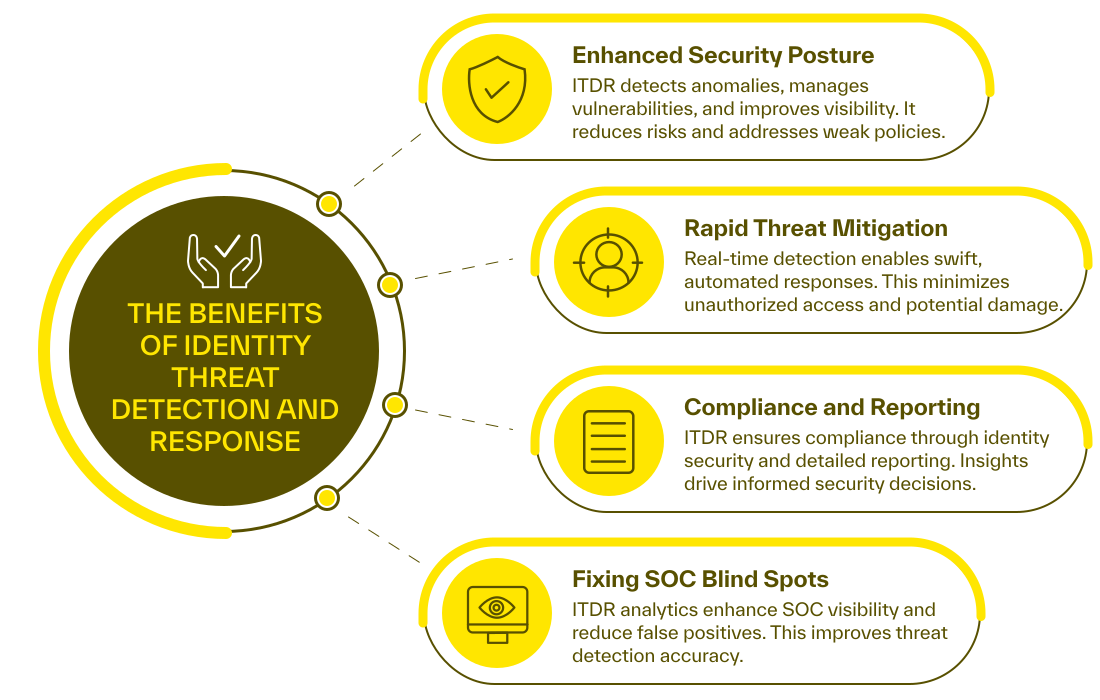
5. Identity threat detection and response
Even strong controls fail sometimes. Identity security plans for that reality.
Identity threat detection and response tools monitor identity activity continuously. They look for signals like unusual login patterns, suspicious privilege escalation, or abnormal data access.
When systems detect risk, they respond immediately. They can revoke sessions, force reauthentication, or restrict access before damage spreads.
This capability turns identity security from prevention alone into active defense.
Social Security identity checks: what changed and why it’s important
Identity security stops being theoretical when money, benefits, and public trust are on the line. That is exactly why recent changes to Social Security identity checks drew so much attention.
The Social Security Administration tightened its identity verification processes to reduce fraud, prevent account takeover, and protect benefits from misuse. Criminals had increasingly targeted Social Security accounts to redirect payments, change direct deposit details, or impersonate beneficiaries.
To counter this risk, the agency strengthened social security administration identity proofing requirements, especially for online access and account changes. These measures aimed to confirm that the person requesting access truly owned the identity tied to the record.
What actually changed
The agency required stronger social security identity verification for certain actions, including benefit claims and account updates. In some cases, users could no longer complete identity proofing online alone. They had to verify their identity in person.
This move triggered widespread discussion about accessibility, delays, and user experience. As a result, the social security administration identity verification process went through adjustments to balance fraud prevention with service availability.
These social security identity verification changes were not random. They reflected a clear security principle: weak identity proofing invites large-scale abuse.
Why identity security teams should pay attention
This case shows what happens when identity becomes the control plane.
The agency did not change its network architecture. It did not add more perimeter defenses. It strengthened identity controls because attackers exploited identities, not systems.
This moment also highlights why identity security news matters beyond government systems. Enterprises face the same challenge at a different scale. If identity proofing fails, attackers gain legitimate access and bypass controls quietly.
When organizations delay identity hardening, they often pay later through fraud losses, account recovery costs, and reputational damage.
Social security identity proofing delay: what it signals for security teams

The social security identity proofing delay that followed the policy rollout revealed an uncomfortable truth about identity security: stronger controls often collide with real-world usability.
When the agency introduced stricter proofing rules, some applicants faced longer wait times and limited options to complete verification. In response, the Social Security Administration adjusted parts of the process to reduce friction while keeping fraud controls in place. That adjustment did not mean the original risk disappeared. It showed how hard it is to balance access and security at scale.
This tension matters for every organization.
Identity security fails when it prioritizes speed alone. It also fails when it ignores user reality. Long delays, confusing steps, or rigid flows push people to seek workarounds. Attackers exploit those gaps.
Strong identity security designs for this from the start. It offers secure fallback paths, clear escalation options, and consistent support when verification fails. It also defines which actions truly require the highest level of proof and which can rely on lower-risk checks.
The lesson is simple. Security teams should expect friction and plan for it. Identity controls must protect the system without breaking trust with legitimate users.
Social Security identity theft: what it looks like and how identity security stops it
Social security identity theft happens when someone uses another person’s identity to access benefits, change payment details, or impersonate them in official systems. These attacks rarely start with system hacking. They start with identity compromise.
A clear social security identity theft description usually includes one or more of the following:
- An attacker takes over an online account and redirects benefit payments
- Someone files claims using stolen personal information
- Fraudsters change contact details to lock out the real owner
- Criminals exploit weak identity proofing to create or manipulate records
These attacks succeed when systems trust identities too easily.
Identity security disrupts this pattern early.
Strong identity proofing makes it harder to create or hijack accounts using stolen data alone. Multi-factor authentication stops attackers who only possess passwords. Behavioral monitoring flags unusual access, such as logins from unfamiliar locations or sudden account changes. Access controls prevent attackers from making high-impact changes without additional verification.
When systems apply identity security consistently, identity theft becomes harder, slower, and more visible. Attackers lose the quiet access they rely on.
This approach explains why governments and enterprises now treat identity as a primary defense. Once attackers control an identity, they often operate undetected. When identity security blocks that control, many attacks fail before damage begins.
Practical checklist: identity security controls you can apply this quarter

You do not need a massive transformation to improve identity security. You need focus, discipline, and consistency. The checklist below reflects what actually reduces identity risk in real environments.
Start with visibility
- Inventory all identities, including users, service accounts, APIs, automation tools, and cloud workloads
- Assign ownership to every identity so nothing operates anonymously
Strengthen identity verification
- Enforce strong authentication for all external and privileged access
- Remove password-only logins wherever possible
- Apply step-up verification for high-risk actions, not just logins
Reduce access risk
- Eliminate shared accounts
- Enforce least privilege across roles and systems
- Replace standing admin access with just-in-time permissions
Monitor identity behavior
- Log authentication attempts and access events centrally
- Flag abnormal patterns such as new locations, impossible travel, or unusual data access
- Treat identity anomalies as security incidents, not audit noise
Automate identity hygiene
- Deprovision access immediately when roles change or users leave
- Run regular access reviews and revoke unused permissions
- Rotate credentials for service accounts and applications
Prepare for failure
- Define clear response steps for account takeover
- Test recovery workflows for locked or compromised accounts
- Communicate identity requirements clearly to users to avoid confusion
This checklist works because it aligns with how attackers operate. They exploit forgotten identities, excessive permissions, and weak verification. Identity security closes those doors first.
Conclusion
Identity security now decides who can access systems, move data, and act with authority. It replaced the network perimeter as the foundation of modern defense.
Recent changes in social security identity verification show how seriously institutions take identity risk. Fraud, account takeover, and misuse forced stronger proofing, even when those changes caused friction. That same pressure exists inside enterprises, cloud platforms, and digital services.
Strong identity security does not aim for perfection. It aims for control. It verifies identities carefully, limits access aggressively, and watches behavior continuously.
Organizations that treat identity as infrastructure protect more than accounts. They protect trust.
Ready to Build a High-Paying Career in Identity Security?
Identity security now sits at the center of modern cybersecurity. As governments and enterprises tighten identity verification, access control, and fraud prevention, professionals who understand identity security are in high demand.
If you’re looking to transition into tech or move into a more secure, high-paying role, cybersecurity remains one of the simplest fields to break into, and identity security is one of its fastest-growing areas. You do not need a degree or prior IT background to get started. You need the right guidance, structure, and roadmap.
Tolulope Michael has helped over 1,000 students transition into cybersecurity roles by focusing on practical, non-technical paths that employers actually hire for.
Book a One-on-One Cybersecurity Career Consultation with Tolulope Michael
If you’re unsure where to start, which cybersecurity role fits you, or how to position yourself for real opportunities in identity security and governance, a short conversation can give you clarity and direction.
This article reflects identity security practices and career pathways as of 2026. Industry requirements may evolve. Always seek up-to-date guidance when planning your transition.
FAQ
What is an identity security platform?
An identity security platform is a centralized system that protects digital identities across their entire lifecycle. It combines identity proofing, authentication, access control, monitoring, and response into one coordinated framework.
Instead of managing identity through disconnected tools, an identity security platform enforces who can access what, under which conditions, and for how long. It also detects suspicious identity behavior and responds automatically when risk appears.
Organizations use identity security platforms to reduce account takeover, prevent privilege abuse, and maintain visibility across human and non-human identities.
What is the difference between IDV and KYC?
IDV (Identity Verification) confirms that a person is who they claim to be. It focuses on validating identity attributes such as documents, biometrics, or trusted data sources.
KYC (Know Your Customer) goes further. It verifies identity and also evaluates risk, intent, and compliance requirements. Financial institutions use KYC to prevent fraud, money laundering, and regulatory violations.
In simple terms:
– IDV answers, “Is this person real?”
– KYC answers, “Should we do business with this person?”
What are the four pillars of identity?
The four pillars of identity provide a simple way to understand how identity systems work.
Identity proofing
Establishes that an identity is real and valid.
Authentication
Confirms that the entity attempting access owns that identity.
Authorization
Determines what the identity can access and what actions it can perform.
Governance and monitoring
Ensures access remains appropriate over time and detects misuse or abuse.
Identity security relies on all four pillars working together. Weakness in any pillar creates risk.
What are the five threats to security?
Most modern security threats fall into these five categories:
– Credential theft through phishing, malware, or data breaches
– Account takeover using stolen or reused credentials
– Privilege abuse caused by excessive or unmanaged access
– Insider misuse, whether accidental or malicious
– Automation and machine identity abuse, including compromised service accounts and API keys
